Key Takeaways
- Structured programs may help build consistency: Structured programs may help new practitioners build confidence and consistency more efficiently than informal onboarding alone
- Phase-based development supports progressive skill building: Breaking onboarding into phases can help prevent overwhelming new hires
- Documentation supports accountability: Structured onboarding and documented internal checkpoints may help support consistency, accountability, and risk awareness
- Early experiences influence long-term outcomes: Early onboarding experiences can influence engagement, confidence, and long-term retention
- Implementation requires infrastructure: Some medical spas may not yet have the infrastructure to execute structured onboarding consistently
You hire an experienced practitioner with excellent credentials. After a brief orientation and a few days of shadowing, you expect independent patient treatment.
Three months later, they still struggle with your software, frequently ask about protocols, and generate patient complaints about communication style.
This can happen in practices that rely heavily on informal onboarding. New practitioners need systematic introduction to your protocols, equipment, documentation requirements, and practice culture.
Why Structured Onboarding Matters
Structured onboarding is often associated with stronger retention, smoother ramp-up, and a better new-hire experience.
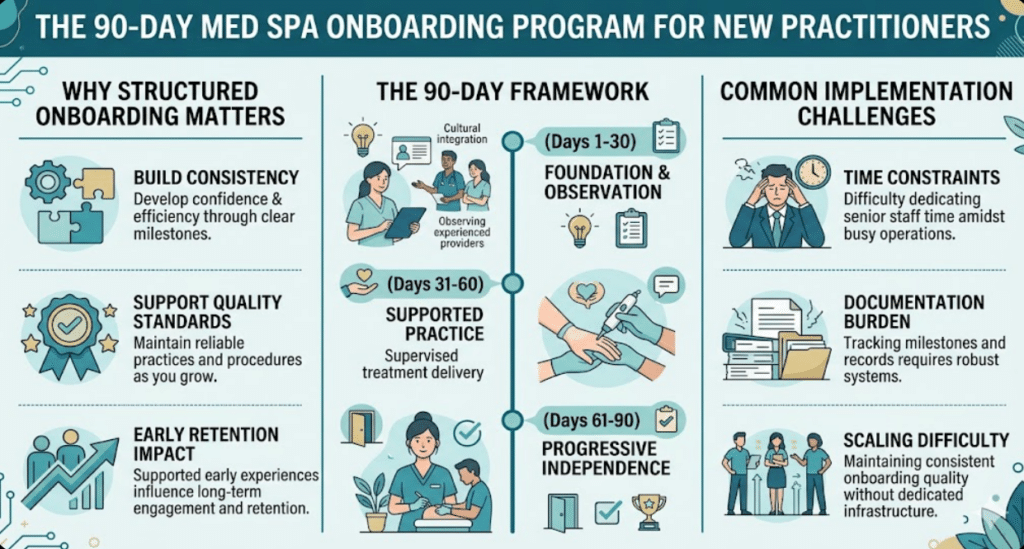
Building consistency: Structured programs may help new practitioners build confidence and consistency more efficiently. Clear milestones and systematic skill development can reduce uncertainty.
Supporting quality standards: Consistent onboarding can help maintain more reliable standards as practices grow.
Early retention impact: Early onboarding experiences can influence engagement, confidence, and long-term retention. Employees who feel supported early tend to stay longer.
The 90-Day Framework
Effective programs often divide the first 90 days into distinct phases:
Days 1-30: Foundation and observation. The first month typically focuses on practice fundamentals, cultural integration, and observation of experienced providers.
Days 31-60: Supported practice. Practices may structure this phase to include supervised treatment delivery, with experienced staff providing real-time feedback and guidance, depending on internal oversight requirements.
Days 61-90: Progressive independence. Many programs transition practitioners toward more independent work with decreasing oversight. The specific approach varies based on practice structure, individual readiness, and applicable requirements.
Common Implementation Challenges
Some medical spas may not yet have the infrastructure to execute structured onboarding consistently.
Time constraints: Busy practices struggle to dedicate senior staff time to comprehensive training. Programs may start strong but become less structured as operational demands increase.
Documentation burden: Tracking milestones, documenting sessions, and maintaining records requires systems many practices lack.
Scaling difficulty: As practices grow and hire frequently, maintaining consistent onboarding quality without dedicated infrastructure becomes challenging.
Supporting Structured Onboarding
At PAVAUSA, we support medical spa practices with operational guidance and systems, while clinical decisions remain under licensed medical leadership.
PAVA supports growing practices with operational guidance, tools, and implementation support that may help create a more consistent onboarding approach.
Operational tracking systems that help document progress and milestone completion
Process templates covering operational procedures, safety protocols, and practice standards
Implementation guidance for structuring phases and maintaining consistency as practices scale
Visit pavausa.com to learn how our platform can help support structured onboarding programs. Move from informal approaches toward more systematic, repeatable onboarding.
Frequently Asked Questions
Can small practices implement structured onboarding?
Even smaller practices can adopt elements of structured programs. Some practices may implement effective onboarding by distributing mentorship responsibilities across team members or adapting timelines based on prior experience, while maintaining internal checkpoints. The key is consistent documentation and clear expectations, not elaborate infrastructure.
What if our experienced hires don’t need 90 days?
Some practices choose to accelerate timelines for highly experienced providers while maintaining documented checkpoints. However, even experienced practitioners typically benefit from structured introduction to your specific protocols, equipment, and patient expectations. Consider condensing the timeline rather than eliminating structure entirely.
Disclaimer: This article provides general educational information about onboarding programs for medical spas. Implementation success varies based on practice size, resources, and commitment. PAVAUSA supports medical spa practices with operational guidance and systems, while clinical decisions remain under licensed medical leadership. Onboarding timelines vary by individual practitioner and cannot be guaranteed. Consult with qualified healthcare and HR professionals regarding onboarding programs appropriate for your specific practice.