
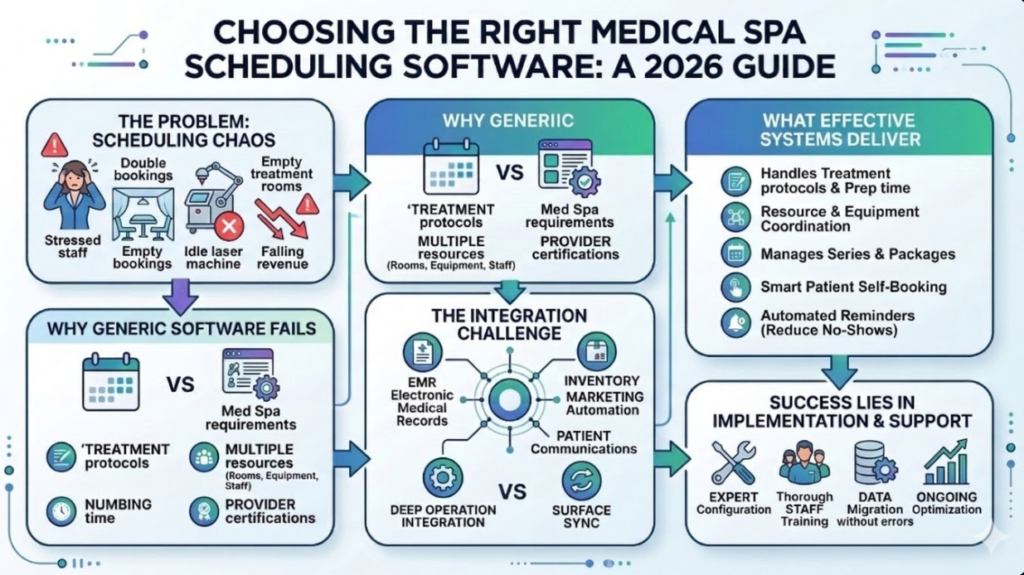
Double bookings create chaos. Patients arrive for appointments nobody scheduled. Treatment rooms sit empty while the schedule shows full. Staff spend hours making confirmation calls for appointments that were already cancelled online. Your expensive laser sits idle because scheduling errors created gaps nobody noticed until patients failed to show.
This is life with inadequate medical spa scheduling software. The daily frustration. The lost revenue. The staff burnout. The patient complaints.
You know you need better systems. The question is what actually makes scheduling software effective for medical aesthetics, and why do so many practices struggle despite investing in new technology?
What Makes Medical Spa Scheduling Different
Generic appointment software fails medical spas because aesthetic treatments involve complexity that basic calendars cannot handle. You are not scheduling simple office visits.
Each treatment requires specific duration, preparation time, numbing periods, and room turnover protocols. Different providers have different skill sets and certifications. Specialized equipment like lasers must be available. Products need to be in stock. Series treatments must space correctly. Package sessions need tracking.
According to medical scheduling research, practices using industry-specific software tend to report better outcomes than those attempting to adapt generic systems. But knowing you need specialized software and successfully implementing it are entirely different challenges.
This is where most medical spas get stuck. Understanding what you need proves much easier than actually making it work in your practice.
The Integration Challenge Nobody Mentions
Scheduling software never operates alone. It must connect with your electronic medical records, billing system, inventory management, payment processing, marketing automation, and patient communications. When these connections fail, staff manually transfer data between systems all day.
Real integration is not just data syncing. When patients book laser hair removal, your system should verify the laser is available, check that products are in stock, ensure the provider is certified for that treatment, pull up the consultation notes, prepare consent forms, and block appropriate time including numbing and cleanup. Automatically.
Most scheduling software companies promise integration. Relatively few deliver the depth of integration medical spas actually need. The difference between surface-level connections and true operational integration determines whether technology helps or hinders your practice.
What Effective Systems Actually Deliver
You need scheduling that handles treatment protocols, coordinates multiple resources simultaneously, manages series and packages intelligently, enables patient self-booking without creating chaos, sends automated reminders that actually reduce no-shows, and integrates deeply with every other system you use.
You also need implementation support that extends beyond software installation. Configuration requires understanding both the technology and medical spa workflows. Staff training must be thorough enough that everyone actually uses the system correctly. Data migration from old systems must preserve years of appointment history without errors.
Then comes ongoing optimization as your practice evolves. New services get added. Provider schedules change. Additional locations open. The system must adapt while maintaining the operational efficiency you fought to achieve.
Why Most Practices Struggle
The problem is not finding software. Dozens of scheduling systems exist. The problem is that buying software and successfully implementing it are completely different challenges requiring entirely different expertise.
You run a medical spa. You excel at aesthetic treatments and patient care. But are you also a software configuration expert? A system integration specialist? A staff training professional? A data migration technician?
Most practices lack the technical expertise and time required to implement scheduling systems effectively. They purchase promising software, struggle through inadequate setup, train staff poorly, then wonder why technology creates more problems than it solves.
This gap between purchasing software and actually using it successfully explains why practices with identical systems achieve dramatically different results. The software itself is only part of the solution.
There Is a Better Way
What if scheduling was not a software problem you solved but a system that just worked? What if every integration happened automatically? What if implementation included complete configuration, thorough training, and ongoing optimization?
At PAVAUSA, we built a comprehensive practice management platform designed specifically for medical spas. Not generic software requiring endless customization. Not basic tools demanding technical expertise to implement. Not surface integrations forcing manual workarounds.
Scheduling that understands medical aesthetics. Integration that connects everything. Implementation that actually works. Support that continues long after setup.
Most medical spa owners spend months evaluating software, weeks implementing poorly, and years fighting systems that never quite work. There is a better approach.
Your practice deserves scheduling that eliminates chaos instead of creating it. Your staff deserve technology that helps them succeed rather than making their jobs harder. Your patients deserve seamless experiences from booking through treatment.
Visit pavausa.com to discover how our platform transforms medical spa operations through systems that actually work the way your practice needs them to. Stop fighting your technology. Start using infrastructure built specifically for aesthetic practices by people who understand your challenges.
The difference between struggling with scheduling software and running smoothly is not which product you buy. It is whether you have the complete system, integration, and support that makes success far more likely, rather than hoping things eventually work out.
Disclaimer: This article provides general educational information about medical spa scheduling software considerations. Individual practice needs vary based on services offered, size, existing systems, and operational requirements. Software effectiveness depends on proper implementation, staff training, and ongoing optimization. PAVAUSA provides integrated practice management platforms but cannot guarantee specific operational outcomes.