New staff make the same mistakes repeatedly. Patients receive inconsistent experiences depending on who serves them. Critical safety steps get skipped when you are not watching. Treatment quality varies wildly between team members. When key employees leave, they take essential knowledge with them.
These problems share a common cause: lack of standard operating procedures. Yet when you decide to finally document your processes, you quickly discover that creating effective SOPs requires far more than writing down what happens in your medical spa.
Most aesthetic practice owners recognize SOPs matter. Few understand what makes procedure documentation truly effective, or why implementation proves so much harder than simply creating documents.
Why Standard Operating Procedures Transform Medical Spas
According to small business process documentation research, businesses with documented procedures achieve higher consistency, faster training, and better scalability than those relying on tribal knowledge. Medical spas amplify these benefits due to regulatory requirements and patient safety considerations.
Documented procedures help ensure every treatment meets safety and quality standards regardless of who performs it. New staff onboard faster when clear protocols exist. Compliance becomes demonstrable rather than claimed. Scaling to multiple locations becomes possible when success does not depend on you personally overseeing every detail.
But knowing SOPs matter and actually building comprehensive, maintainable procedures are entirely different challenges. This gap is where most practices get stuck.
The Overwhelming Scope Nobody Talks About
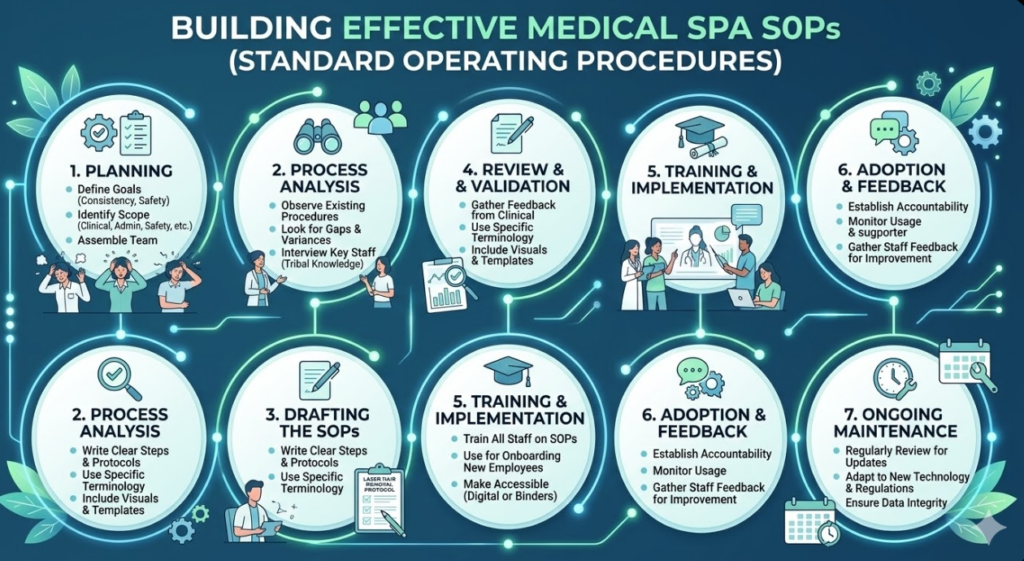
Medical spas require procedures for clinical protocols, administrative processes, safety requirements, equipment maintenance, inventory management, patient communications, emergency responses, staff training, quality assurance, and regulatory compliance. Each treatment involves multiple steps. Each role requires specific procedures. Each piece of equipment needs documentation.
You quickly realize you need to document dozens—sometimes even hundreds—of processes. Where do you start? Which procedures matter most? What level of detail is appropriate? How do you organize everything so staff actually use it rather than ignoring binders gathering dust?
Most practices start enthusiastically documenting procedures, then abandon the effort when the scope becomes overwhelming. The ones who persist often create documentation so detailed nobody reads it, or so vague it provides little actual guidance.
Why SOPs Become Outdated Immediately
Creating initial SOPs proves challenging. Maintaining them proves impossible for most practices. Treatment protocols change. Equipment gets upgraded. Regulations evolve. Staff provide feedback requiring procedure modifications. New services launch needing documentation.
Without systematic approaches to procedure updates, SOPs become outdated within months. Staff stop trusting documentation that contradicts current practices. New employees learn from experienced staff rather than written procedures, perpetuating inconsistencies the SOPs were supposed to eliminate.
Research from process improvement experts shows that procedure maintenance often consumes more resources than initial creation. Most medical spas lack systems for version control, update distribution, and ensuring staff work from current procedures rather than outdated documents.
What Makes SOP Implementation So Hard
The challenge is not writing. Anyone can document what they do. The challenge is creating procedures that balance comprehensiveness with usability, provide sufficient detail without overwhelming, organize logically for easy reference, integrate with training systems, update efficiently as processes evolve, and ensure staff actually follow documented procedures rather than improvising.
This requires expertise in instructional design, process analysis, quality management, and change implementation. Most medical spa owners excel at aesthetic treatments and patient care, not procedure documentation and organizational systems design.
Then comes the implementation challenge. Creating procedures achieves nothing if staff do not use them. Adoption requires training, accessibility, accountability, and cultural integration that most practices struggle to establish without dedicated focus.
Why Most Medical Spas Abandon SOP Projects
Medical spa owners start SOP projects with good intentions. They purchase templates promising quick implementation. They dedicate weekend hours to writing procedures. They create beautiful binders or fancy digital folders.
Then reality hits. Templates designed for generic businesses miss medical aesthetics specifics. The time required exceeds estimates by multiples. Staff resist following documented procedures, claiming their way works better. Keeping documentation current while running the practice proves impossible.
The project stalls. Partially completed procedures sit unused. Operations continue relying on institutional knowledge residing in key employees’ heads. The practice remains vulnerable to staff turnover, inconsistent quality, and scaling limitations.
There Is a Better Approach
What if you had comprehensive medical spa SOPs built by people who understand aesthetic practice operations? What if procedures stayed current automatically as best practices evolved? What if implementation included the training and accountability systems that ensure staff actually use documentation?
At PAVAUSA, we built a comprehensive operational framework medical spas need, including comprehensive procedure documentation that covers clinical protocols, administrative processes, safety requirements, and compliance obligations specific to aesthetic practices.
Not generic templates requiring extensive customization. Not blank documents demanding hundreds of hours writing from scratch. Not procedures that become outdated immediately. Comprehensive, up-to-date, medical spa-specific SOPs integrated with training systems, quality management, and operational platforms.
Most practices spend months attempting to create procedures independently, achieve partial results, then watch documentation slowly become irrelevant. There is a better way.
Your practice deserves operational excellence built on documented procedures that ensure consistency, support training, enable growth, and protect quality. Your staff deserve clear guidance rather than guessing how things should be done. Your patients deserve predictable experiences regardless of who serves them.
Visit pavausa.com to discover how our platform provides the complete operational infrastructure medical spas need, including comprehensive SOPs that eliminate guesswork and enable confident scaling. Stop struggling to document procedures while managing your practice. Start using systems built by experts who understand exactly what medical spas require.
The difference between having SOPs and having effective operational procedures is not just documentation quality. It is whether you have the complete system, training integration, maintenance infrastructure, and implementation support that makes procedure adoption far more likely, rather than merely hopeful.
Disclaimer: This article provides general educational information about standard operating procedures for medical spas. Individual practice needs vary based on services offered, size, state regulations, and operational complexity. Effective SOP implementation requires commitment to documentation, training, and quality management. PAVAUSA provides operational frameworks and procedure documentation but cannot guarantee specific operational outcomes.