Key Takeaways
- Structured onboarding significantly improves retention: Comprehensive first-week programs set clear expectations and build confidence from day one
- Clinical competency reduces stress and turnover: Ongoing skills development ensures staff feel prepared and capable in patient-facing roles
- Career pathway visibility increases commitment: When employees see clear advancement opportunities, they invest in staying long term
- Consistent training creates cultural cohesion: Standardized programs ensure every team member receives the same foundational knowledge
- Documentation and systems enable scalability: Written protocols allow training quality to remain consistent as your practice grows
You hire promising staff with impressive credentials and genuine enthusiasm. Within months, they leave. The cycle repeats. Recruiting costs accumulate. Patient care suffers during constant transitions. Your remaining team carries extra burden while new hires get up to speed.
Most medical spa owners blame the labor market, generational differences, or unrealistic employee expectations. But practices with strong training systems often see lower turnover than industry averages, retaining staff for years while competitors constantly recruit.
The difference is not the people you hire but how you develop them after they arrive. Effective training programs create competent, confident staff who see clear career paths and feel valued through ongoing investment in their professional growth.
Why Medical Spa Training Programs Reduce Turnover
According to research on employee retention, structured onboarding and training programs significantly impact how long employees stay with organizations. The medical aesthetics industry sees particularly high impact because technical competency directly affects job satisfaction and patient outcomes.
New staff feel overwhelmed without clear guidance: Medical spas involve complex protocols, diverse services, specialized equipment, and high patient expectations. Without structured training, new hires feel lost, stressed, and inadequate. This anxiety frequently contributes to early turnover.
Competency builds confidence and job satisfaction: When staff master skills progressively through systematic training, they develop confidence that enhances job satisfaction. Competent employees perform better, receive positive patient feedback, and want to continue developing their expertise.
Training signals investment in employee growth: Comprehensive training programs demonstrate that you value staff development beyond immediate productivity. This investment creates reciprocal loyalty. Many employees feel more committed to staying after receiving meaningful training and development.
Clear expectations prevent frustration: Structured training communicates exactly what success looks like in every role. This clarity eliminates the frustration of unclear expectations that often drives early departures.
Essential Components of Effective Medical Spa Training
The most effective programs tend to follow structured progressions that build competency systematically rather than overwhelming new hires immediately.
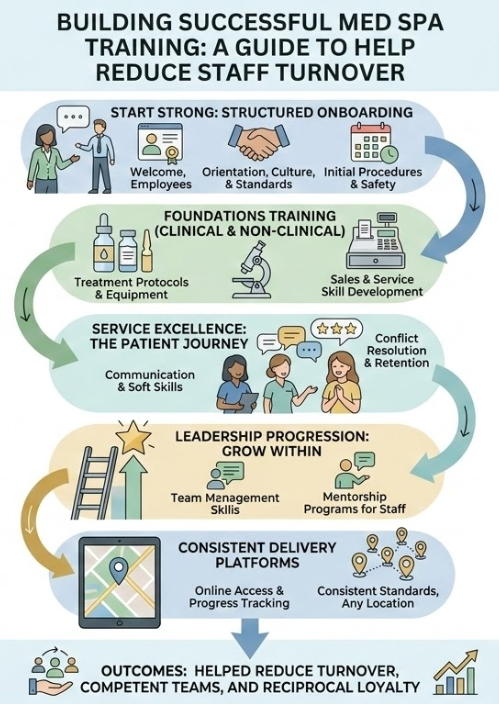
Structured first-week onboarding: Comprehensive programs covering culture, operations, systems training, safety protocols, and initial clinical introduction set the foundation for success.
Progressive clinical competency development: Systematic skill building that starts with foundational techniques before advancing to treatment-specific modules and ongoing refinement ensures confidence and capability.
Customer service excellence: Communication skills, experience creation, and difficult situation management training ensure staff can deliver the exceptional patient experiences that drive practice success.
Career development pathways: Clear advancement opportunities with defined progression levels, specialization options, and leadership development keep ambitious staff engaged long term.
Why Most Medical Spas Struggle With Training Implementation
Understanding what effective training requires differs dramatically from actually implementing it consistently. Most medical spa owners face several common obstacles.
Time constraints: Building comprehensive training materials, conducting training sessions, and maintaining programs requires substantial time investment that busy owners struggle to allocate while managing operations.
Inconsistency across trainers: When different team members train new hires without standardized materials, training quality varies wildly. New staff receive conflicting information creating confusion and frustration.
Lack of documentation: Without written protocols and training materials, institutional knowledge lives only in employee heads. When staff leave, training expertise leaves with them.
Scaling challenges: Training that works with three employees often breaks down when you have fifteen across multiple locations. Informal approaches do not scale.
The Training Infrastructure Gap
You recognize training’s importance. You understand the components effective programs require. You want lower turnover and higher-performing teams. But creating and maintaining comprehensive training infrastructure while running your medical spa proves overwhelming.
Building training materials requires expertise in instructional design, medical aesthetics, customer service, sales, and operations. Maintaining these materials as treatments evolve, equipment changes, and best practices advance demands ongoing attention few practice owners can provide.
Building this infrastructure internally demands resources most aesthetic practices don’t have without sacrificing patient care or business operations. This infrastructure gap explains why practices with identical understanding of training best practices achieve dramatically different retention outcomes.
Building Training Systems That Actually Work
Effective medical spa training requires comprehensive materials, structured delivery systems, competency tracking, and ongoing updates. Building this infrastructure internally demands resources most aesthetic practices cannot dedicate without sacrificing patient care.
At PAVAUSA, we provide a comprehensive training infrastructure designed to help medical spas reduce turnover and build high-performing teams without the overwhelming burden of creating everything from scratch.
Comprehensive onboarding programs covering first-week essentials, operational systems, safety protocols, and cultural integration with ready-to-use materials and structured timelines
Clinical competency frameworks that build skills progressively across all common medical spa treatments with assessment tools ensuring staff competency before independent practice
Career development pathways clearly defining advancement opportunities, competency requirements, and compensation progression that keeps ambitious staff engaged long term
Training delivery platforms that enable consistent program delivery whether you have one location or ten, tracking completion and supporting consistent quality regardless of who conducts training
Visit pavausa.com to discover how our platform provides a comprehensive training infrastructure that helps reduce turnover, builds competent teams, and significantly reduces the burden of creating training programs from scratch. Stop losing staff to inadequate development. Start building teams that stay and perform.
Your staff deserve professional development that builds their competency and careers. Your practice deserves retention rates that support growth rather than constant recruitment. The training infrastructure to achieve both exists now.
Disclaimer: This article provides general educational information about medical spa staff training and retention. Individual practice results vary based on numerous factors including market conditions, management practices, compensation structures, and organizational culture. Turnover reduction outcomes depend on comprehensive implementation of training systems along with other sound employment practices. PAVAUSA provides training infrastructure and operational support but cannot guarantee specific retention outcomes. Consult with qualified HR professionals and employment law attorneys regarding staff development and retention strategies appropriate for your specific practice.